
Leading to a clean economy
Read time: 4 min
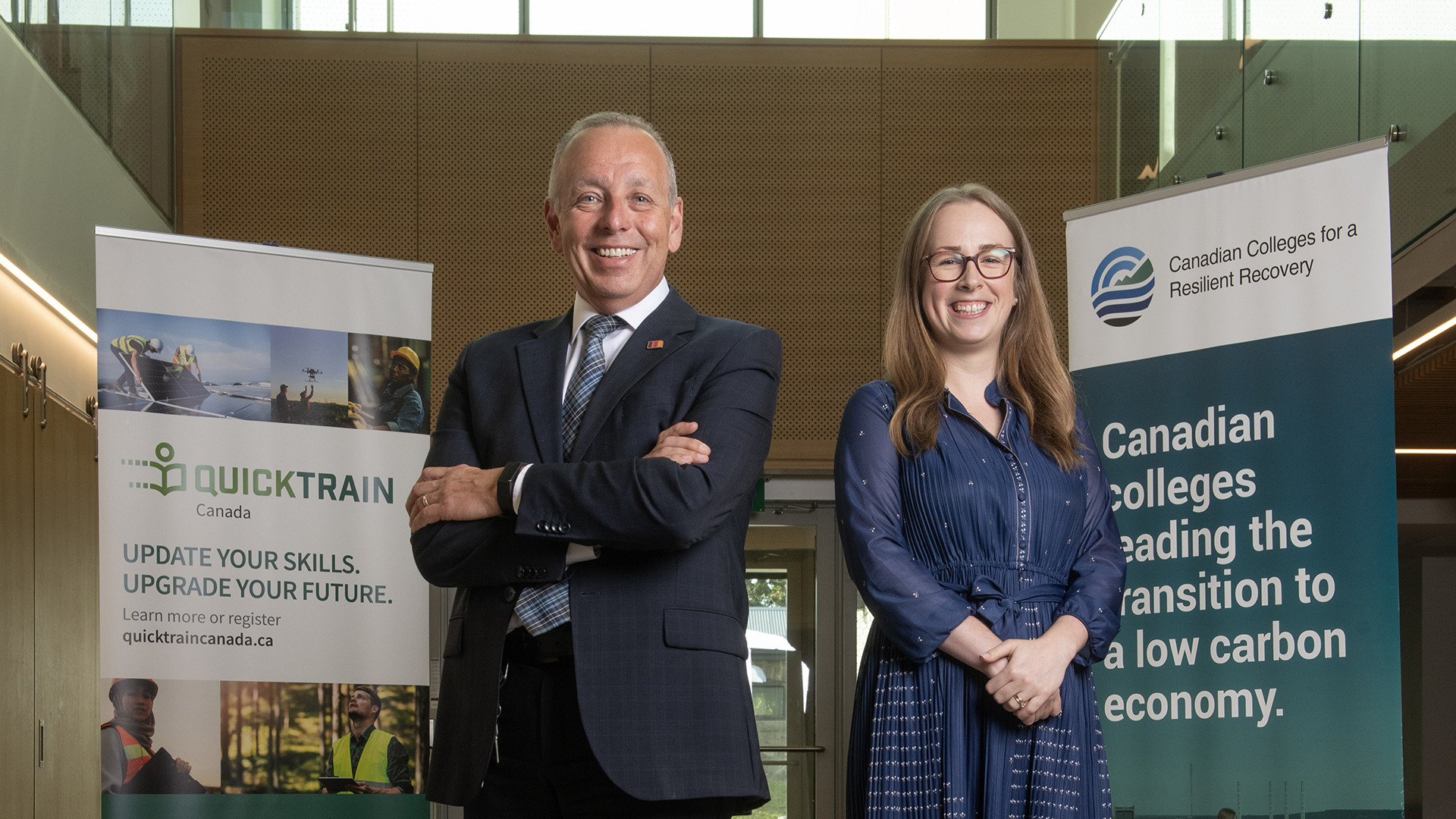
Canadian Colleges for a Resilient Recovery’s Quick Train Canada is providing a suite of upskilling, reskilling options for workers across the country.
Canadian Colleges for a Resilient Recovery (C2R2) is a nationwide effort led by Mohawk College to coordinate, amplify and accelerate the training and research necessary for the transition to a clean economy.
That foundational organization of 14 partnering colleges, cégeps, institutes and polytechnics from across Canada with strength in climate action and sustainability has now launched Quick Train Canada, a fully funded suite of microcredentials. They cover a wide variety of sectors, including agriculture and agri-food, transportation, natural resources and environment, clean technology, construction and industry development.
Through in-person, virtual and hybrid offerings, learners can choose from microcredentials offered at institutions across Canada. The goal is to train 10,000 people.
“As smart technology advances and the clean economy rolls out across the country, existing industries are adapting to remain competitive and new industries are gaining a strong foothold in the economy,” says Mohawk College President and CEO Ron J. McKerlie.
Quick Train Canada gives workers an opportunity to prepare themselves today to be forerunners in the workforce of tomorrow.

Mohawk College founded C2R2 in the fall of 2020 and now acts as its coordinating secretariat.
“Quick Train Canada offers short, agile training targeting those already in the workforce. For some individuals, it might not be feasible to go back to school for a diploma or degree, but with the flexibility of microcredentials it is possible to upskill into a new position or a new industry,” says Adrienne Madden, Coalition Manager of C2R2.
In November 2022, the coalition received $46.5 million in funding from Employment and Social Development Canada under its Sectoral Workforce Solutions Program to support an education solution for all Canadians.
“The power to make a large impact quickly is 100 per cent the reason for the coalition,” says Paul Armstrong, Chief Operating Officer for Mohawk College and C2R2 Steering Group Co-Chair. “The members share an honest commitment to removing barriers and applying a national approach so that we can respond quickly to match the needs of a quickly changing economy.”
Each member institution leads in curriculum development, training and applied research within its own realm of expertise.
“That kind of coordinated effort on this scale has never been applied within the college system before. It’s a very efficient model because it eliminates duplication and the unnecessary expenditure of resources. Fourteen institutions are acting as one,” says Armstrong.
A key pillar of C2R2 is one of fostering inclusion, diversity and equity to ensure equitable access to opportunities. In order to ensure that C2R2’s work reflects the needs of business and industry, the coalition has established a national industry advisory council that brings together the voices of large industry sectors, Indigenous peoples, youth and other underrepresented groups.
So far, more than half of Quick Train learners identify as being among an equity-deserving group, which includes women, Indigenous people, racialized and visible minorities, people with disabilities, 2SLGBTQIA+ and newcomers.
“There is strength in this shared mission, this shared vision to work together and in the commitment to EDI (equity, diversity and inclusion),” says Christine Watson, Vice President, Academic at Red River College Polytechnic (RRCP) in Manitoba, one of C2R2’s founding members.
RRCP offers microcredentials in electric vehicle (EV) technology, EV communications and computer systems, building envelope science and working in social innovation andconsultation with Indigenous communities. It will soon roll out courses in hydrogen production, diesel exhaust emission reduction systems and hydrogen fuel cell vehicles.
“We know other colleges have expertise that we don’t have so it’s an opportunity to leverage our strengths and to call upon the capacity, resources and expertise of all the other colleges,” said Watson, who co-chairs the C2R2 steering group alongside Armstrong.
“This is the right time and these are the right offerings. Demand has been high for our training options. The majority of our learners are employed and are looking for shortburst training for new jobs or new fields. And because the federal government has backed this model, Canadians have access to training in a way they never have before,” she says.
“We are so impressed by the vision and leadership that Mohawk College and Ron and Paul brought forward. We cannot take this on individually. It has to be a collaborative, collective response.”
The need for this type of skills training is enormous.
The C2R2 secretariat team centred at Mohawk College is made up of nine people, including staff seconded from four member institutions. That secretariat provides administrative, communications and government relations support to the coalition and its associated groups, leads all grant applications, handles all day-to-day operations, and drives business development opportunities.
This story originally appeared in Momentum Magazine.